
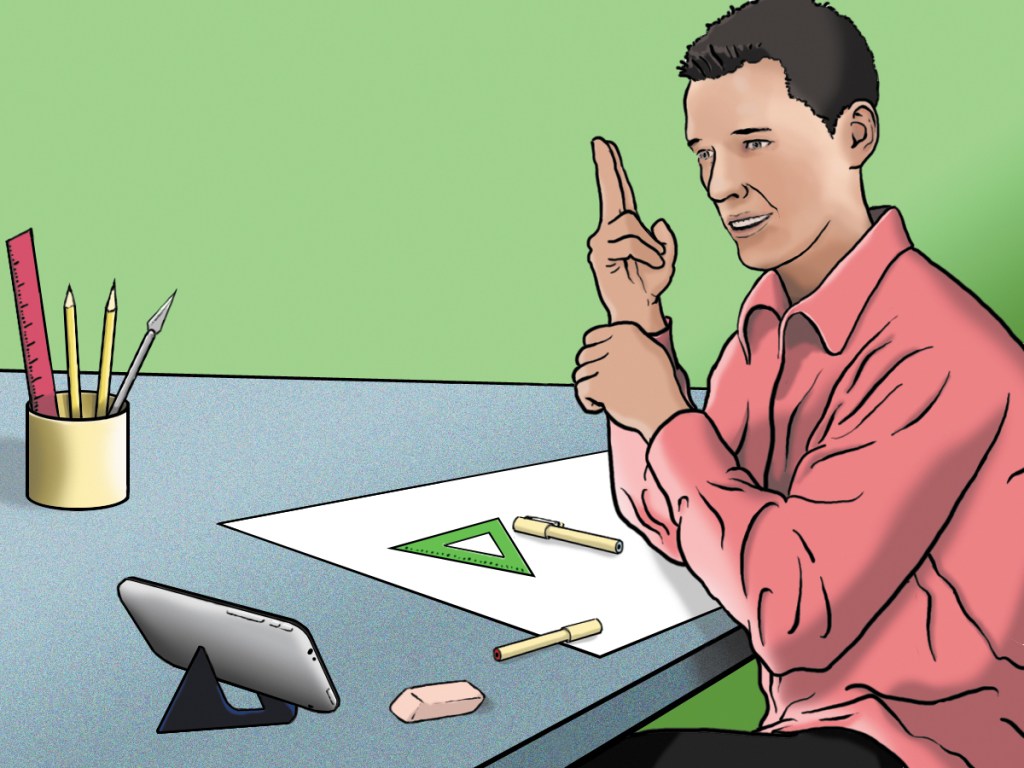
An accessibility persona from A Web for Everyone — The nice thing about being a graphic artist is that most of the time his work can speak for itself.
My only disability is that everyone doesn’t sign.
When he first started working, most reviews were done in meetings, but more and more his agency works with clients using online workspaces. He’s had some projects recently where all of the communication was through the web. Although he likes seeing live reactions, it’s easier for him to participate in the project forum discussions using text rather than audio. His iPhone has also been important. It was his first phone with a good way to do video chat so he could talk to his friends who sign.
It’s annoying when videos on the web aren’t captioned. How is he supposed to learn about a new app if the only information is an animated video? Or if he’s the only one in the office who doesn’t get the joke?
Like many people who learned ASL as their first language, Steven prefers sign, but reads text, since that’s most of what the web is. If a site is just a big wall of text, he’s likely to leave unless he knows it’s got the information he needs.
Without captions, it’s meaningless to me.
There’s not much more to say about audio without video. Steven explains why captions are so important to him. “I love that there is so much visual information on the web, but when it comes to videos, why can’t people take the time to include me? For example, I was trying to learn how to use a new application, and the only instructions were in a screencast. I could sort of follow what they were doing, but when someone interpreted for me, I found out that I misunderstood an important point. It makes me so frustrated. I’m good at what I do, and don’t like being left out or having to ask someone to interpret information for me.”
Snapshot of Steven
- 38 years old
- Art school
- Graphic artist in a small ad agency
- iPad, iPhone, MacBook Pro; good computer at work
The A’s: Ability, Aptitude, Attitude
- Ability: Native language is ASL; can speak and read lips; uses SMS/IM, Skype, and video chat
- Aptitude: Good with graphic tools, and prefers visuals to text; poor spelling makes searching more difficult
- Attitude: Can be annoyed about accessibility, like lack of captions
Assistive Technology
- Sign language
- CART—Communication Access Real-Time Transcription—captions for meetings and phone calls
- Captions
- Video chat
The Bigger Picture
Source: Gallaudet University/U.S. Census, audio-accessibility.com, Hearing Loss Association of America
- 10.5 million (3.5%) people in the U.S. are deaf or have a significant hearing loss and 48 million people in the U.S. report some degree of hearing loss.
- 500,000 to 2 million people use American Sign Language (ASL).
- Sign is not a universal language. There are national versions around the world, such as Auslan (Australian Sign Language) and three different sign languages in Japan.
By Whitney Quesenbery, illustration by Tom Biby
From Horton, S., & Quesenbery, W. (2014). A Web for Everyone: Designing Accessible User Experiences. Rosenfeld Media, Brooklyn, New York.
 Know About Accessibility